
It’s no secret that teacher workloads are generally pretty high. Those who haven’t been in a school since they were in school might suggest it’s a cushty 9-3 job with tonnes of holiday. The holidays are nice, sure, but I tend to spend most of my holidays working on research stuff, and I usually have a bit of teaching-related stuff to do too. Most of my teacher friends also spend at least a few days each ‘holiday’ working, catching up on admin, and preparing for the next half term.
This begs the question, how do I manage to do so little school work during the breaks? Part of it is sometimes needing to work fairly long hours during term term, but I’m pretty firm on not working longer hours than I have to, and I don’t really ever take work home with me.
Given that the summer term has started (and with the exam situation, it’ll be a long one…), in this blog, I’ll outline the two main marking & feedback strategies I use to help reduce my workload.
Self- or peer-marking
One of the biggest time-sinks for teachers is marking. Sometimes this is really beneficial, and I’d be lying if I said I never mark any work. (I’d also be pretty poor at my job). However, it’s important to only mark the work that’ll actually have an impact. There is literally no point in ‘tick and flick’ marking.
I like having students practise lots of exam questions during lessons; they’re useful for applying knowledge as well as helping to develop familiarity and skill with exams so it’s not quite so daunting when the formal ones come up. Any questions like this, the students mark during the lesson.
Whilst self- or peer-marking is easy for numerical questions, for the longer questions it’s a bit more difficult. At the beginning of the year I’ll spend time modelling how to mark questions, and we’ll spend time as a class working out how to agree on whether an answer matches the mark scheme enough to justify awarding marks. Having students mark example answers (e.g. their peers’ answers, or ones I’ve written) helps with this.
This takes a fair bit of training, and there will always be questions from students about “does this count?”, but spending 10-15 minutes in lessons marking as a class is a far better use of time than spending 2 hours of my evening marking students’ work only for them to look at the score, and not the actual feedback. In addition, it means that when they’re doing past papers for revision when they’re older, they can mark their work properly. HINT: a visualiser is an absolute must for modelling. If you don’t like the visualisers available, then a ‘gooseneck’ and iPad that streams to the board will work too.
Providing whole-class feedback
When I do need to mark work in full myself, I generally won’t leave written comments for students. (I might do for A level students because there aren’t many of them, but for a class of 32 KS4 students this isn’t really feasible). Instead, I’ll pick up on common misconceptions as I go through the work, and either:
- Give three targets (literally two or three numbers, circled), and display the corresponding tasks on the board when feeding back to students. They identify their weaker areas (and their strengths, too), and work on those. This is my preferred method because it saves me time, but students all get targets and feedback from me that is personal to them. The picture below shows an example of some points I wrote down whilst marking some Year 10 papers about Waves and the EM spectrum.
- Provide a generic list of misconceptions / issues to everyone. (This is more common if I’m behind where I should be on the schedule or pushed for time…). It takes up less time, but is also less effective because students are unsure which points apply to them.
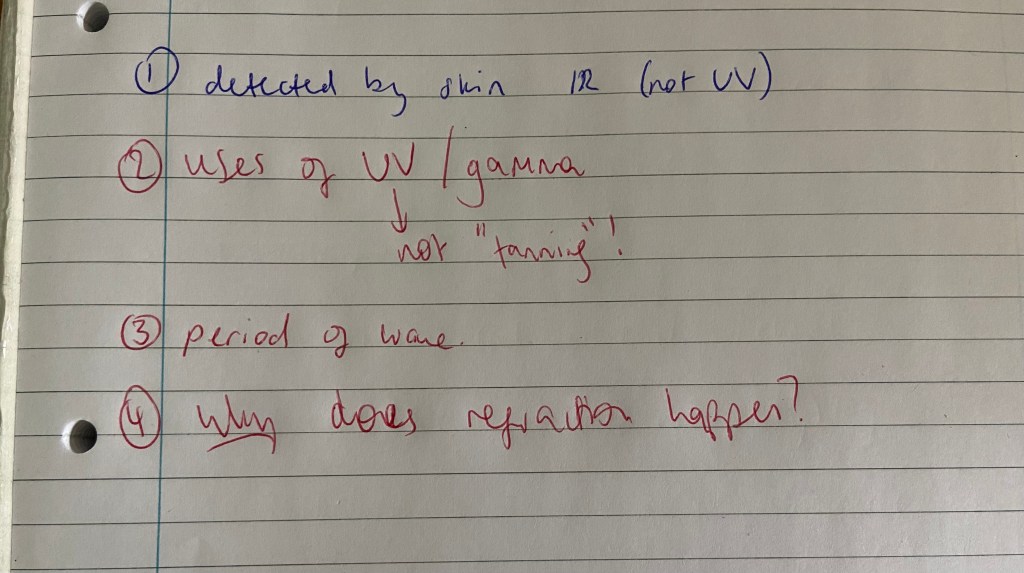
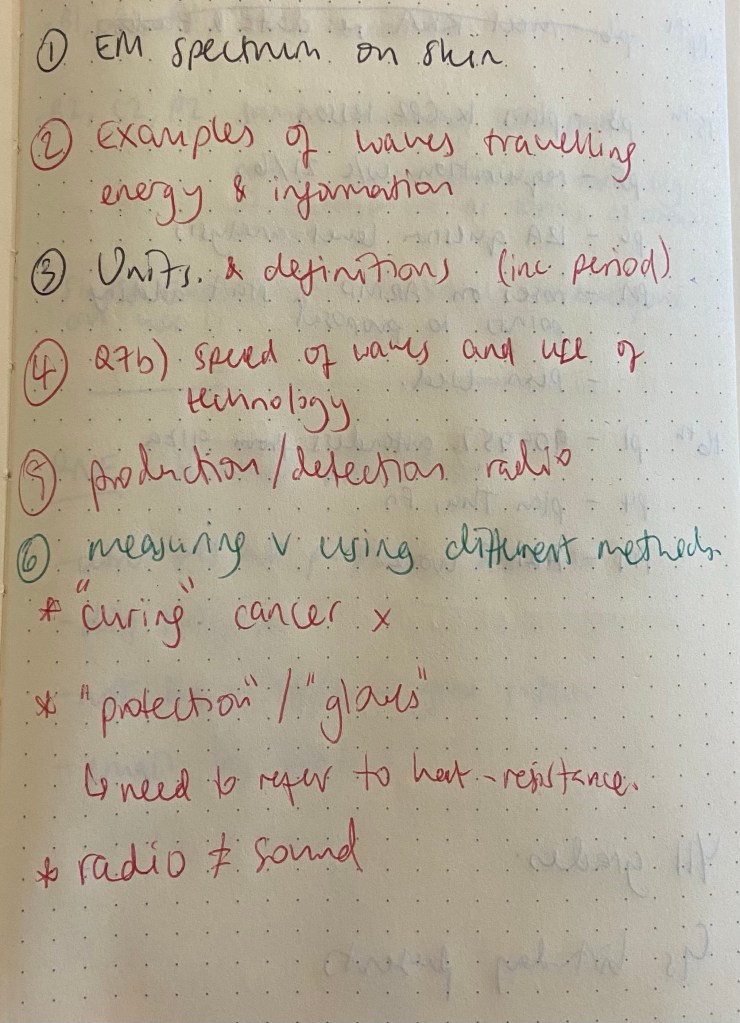
Once the class has their feedback, there’ll be specific tasks that they can act on to improve their work. Because there are only, say, six to eight tasks, and the students will need to complete at least three, this saves time on planning a huge series of independent tasks too.
In addition to these tasks, students will usually be expected to add corrections or make edits to their answers, in a different colour, on the test paper.
I don’t really like marking, but I can’t imagine how much I wouldn’t enjoy it if I also had to leave individualised written comments. No thanks!
 odeneal.blog
Leave a comment