
After a wee break whilst my supervisors, David and Dillon, marked my proposal, I’m absolutely elated to say it passed, and I’ve been allowed to continue to the thesis stage of the EdD. Woohoo!
I’d like to add at this point that both were instrumental in helping me develop my thinking, and provided really helpful feedback throughout the writing process.

Given that I’ll be going ahead with the research, I thought it would be a good idea to give a VERY brief outline of what I’ll be researching over the next few years in this post. I don’t often get to talk about my research so any comments and questions are welcome. The poster I used to help me develop the proposal can be found here.
Also, this study will likely change over the course of the next few years, and maybe it’ll be really similar, or maybe it’ll wind up being entirely different. We’ll see.
Current literature, targets, and self-determination theory
This study, as the title suggests, is all about whether the use of target grades are actually motivational for secondary students. The use of target grades and their impact on the type of motivation induced in students (if any motivation is induced, of course) aligns nicely with self-determination theory (SDT), which I’ll do a post about soon. The image below shows a model, published in a paper by Gagné and Deci (2005), that I think really nicely summarises how students might experience motivation.
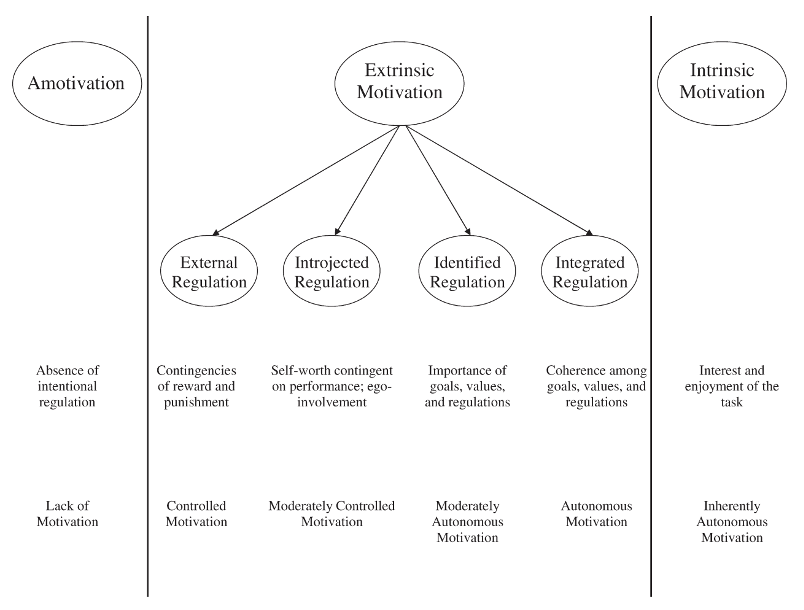
SDT is quite trendy at the moment, and there’s lots of literature about it, including in academic settings in schools. However, it’s currently unclear what kind of motivation students have as a result of their target grades, or whether amotivation is created instead. (There is more of this in the actual proposal, which I’m happy to share if requested!)
It could be easy for teachers to use negative language (Soenens et al., 2012) and therefore demoralise students, causing amotivation. This might happen if a student doesn’t meet their target in an assessment, for example. However, if teachers facilitate autonomy in the classroom and use targets to enhance this, then students may become additionally motivated. This study aims to help schools work out whether the practice of issuing targets is really worth it.
Research Questions and Methods
Here I’ll outline the RQs I’m planning to answer, and the methods I’ll use to try and do that. I’m considering the use of a fifth research question, but this will develop over time.
| Research Question | |
| 1 | To what extent do students perceive the use of target grades as motivational? |
| 2 | What type of motivation do students experience, and does this align with their perceptions of the use of target grades? |
| 3 | Do students’ motivational types and perceptions of the use of target grades alter over the course of an academic year? |
| 4 | What are teachers’ perceptions of the use of target grades, and to what extent to they think target grades are motivational for students? |
Method 1: Psychometric testing (RQ 1, 2, 3)
The use of the Self-Regulation Questionnaire – Academic (SRQ-A) will allow me to measure the extent to which students experience different types of motivation, namely external, introjected, identified, intrinsic (or amotivation). Doing this over the course of a year with Years 10 and 11 will mean I can identify any patterns over time.
Method 2: Focus groups with students (RQ 1, 3)
Allowing students a platform to voice their views in small groups means that they’ll hopefully feel comfortable sharing, and will be able to give more context to the scores on the SRQ-A. More information and context from students will always be helpful.
Method 3: Semi-structured interviews with teaching staff (RQ 4, kind of supports 1)
Teaching staff will have the opportunity to provide some context about the schools the research takes place in, and give their views on how they use targets, what they think of their effectiveness, and how they think students respond to them.
Affordances and limitations
In general, confirmation that these targets are actually increasing students’ motivation would be valuable for teachers to have. It’s baffling that this isn’t something that has been measured in a study previously. Helping teachers to develop strategies to encourage autonomous motivation (whether that turns out to be target grades or not) can only be a good thing. It’ll also help bridge aspects of academic literature together.
However, clearly no research can ever be perfect. Self-report surveys are not always entirely reliable (thus the methods to try and mitigate this), and students are not always honest. At the moment I’ve got two or three schools in mind for this research, but this leaves a relatively small sample size (compared to nationally) and so I’m going to try and build this too.
In summary, this is a brief overview of what I’ve proposed. Like I said, it’ll likely develop over time and I’ve left lots of detail out of this post (questions and comments welcome!). I think it’s going to be super interesting (I mean, of course I do), and I can’t wait to get started.
If you would like to read the full proposal, please let me know! Happy to share.
References
Gagné, M. and Deci, E. L. (2005). Self-Determination Theory and Work Motivation. Journal of Organizational Behaviour, 26(4), 331-362.
Soenens, B., Sierens, E., Vansteenkiste, M., Doochy, F. and Goossens, L. (2012). Psychologically Controlling Teaching: Examining Outcomes, Antecedents, and Mediators. Journal of Educational Psychology, 104(1), 108-120.
 odeneal.blog
Leave a comment