
A couple of months ago I ran a workshop for the staff at my school on using metacognition in the classroom. The big thing to take away from it was that it’s not something we can teach once, and then leave. We need to embed strategies in our lessons that work because of metacognition.
It is not a single lesson to cover once in Year 7, only to be forgotten about for the rest of time. (I mean, it could be that I suppose, but that’d be wholly useless.)
What is metacognition?
In my mind, metacognition is basically the conversation a student has with themselves about their work. What do they need to do? How will they do it? Deciding what previous knowledge to rely on, and how to structure their work, as well as maybe why they’re doing it that way.
This is a skill that students need to practice consistently across the range of subjects in school, and regularly throughout their schooling.
What does this look like in my classroom?
Plan, monitor, evaluate
The crux of it is ensuring that students plan what they’re going to do – what is the question asking of them? What connections can they make to previous knowledge? What skills do they need? What approach will they take?
Taking time before actually attempting a task to consider how best to answer it is invaluable. I’d argue the evaluation stage is just as important – consideration of what worked well about a strategy (and what didn’t work so well) will help to prepare students better for future problems that’ll need solving.
I, We, You
This common modelling technique is useful for demonstrating to students the process that someone needs to go through to be successful with a task. This could be learning to use a new equation, planning a longer response exam question, or (with my Y12 Sociology class), modelling marking a 30 mark essay question. A visualiser is particularly helpful for this.
Diagram construction for explanations
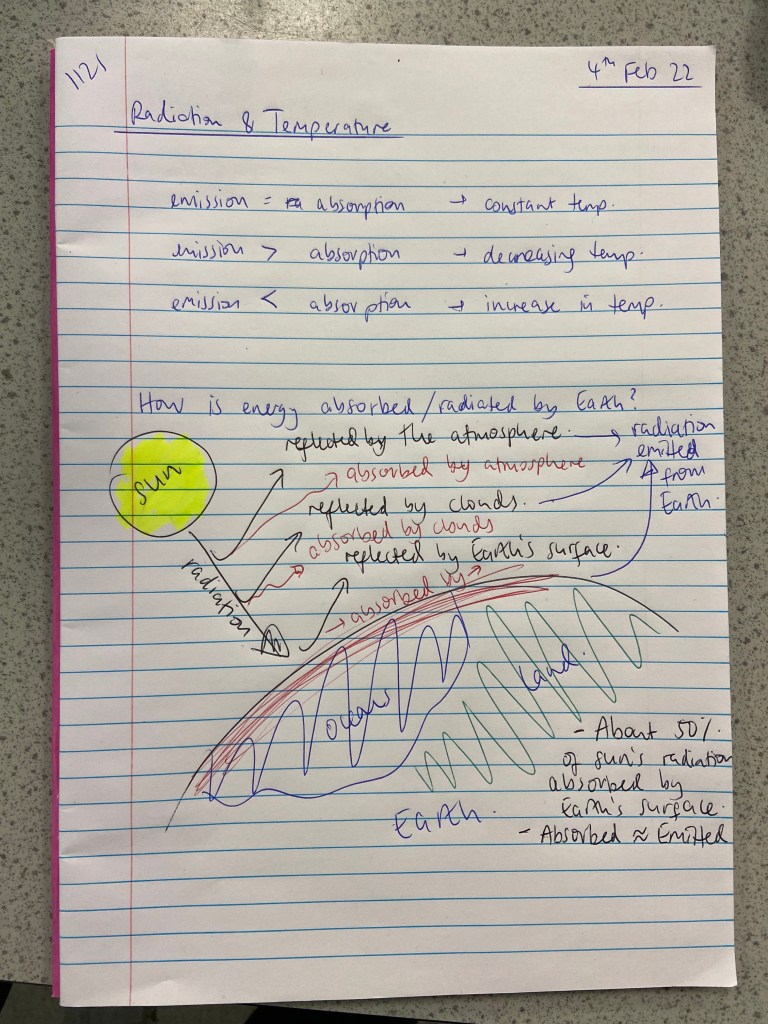
Showing students the process of building the diagram from scratch helps to break down the content into a bitesize chunks.
How is this metacognition though? This example (from a lesson on radiation and temperature) helps to demonstrate all the different layers of the atmosphere/planet, and what the radiation is doing at these places.
It breaks down the knowledge to help make it clear where we can make links to other things we’ve learned about, and ensures better comprehension of each part of the process of absorption/emission of radiation. It means I had to go at the same pace as the students.
The black arrows came first, followed by the red arrows, then followed by blue. (Then I added the bit in black in the bottom corner).
Ideally I’d have left a bit more space for adding the arrows & information bit by bit around the actual diagram!
Challenging application questions
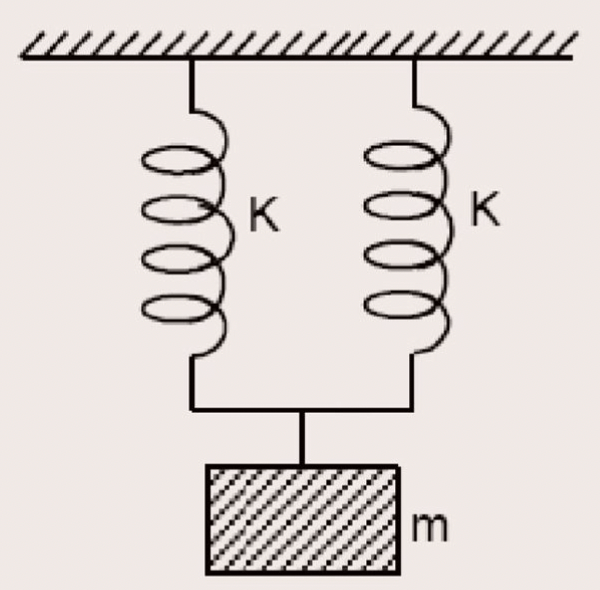
Sometimes these questions might be extensions, but they don’t need to be. Asking students questions like ‘what if…?’, whilst changing small aspects of what they’re learning about, forces them to consider what links to previous material need consideration, and how the process of solving the problem needs changing based on this new information.
An example of this might be ‘what happens if I hang the masses onto two springs that are next to each other instead?’ in a lesson on Hooke’s law (like in the diagram).
I have a bunch of other strategies I’ve used but I’ll post about those another time…


Leave a Reply