
In January I was appointed as the KS3 Science Coordinator at my school on a maternity cover basis, as part of the cover for our Second in Science who’s on maternity leave. This means I have until Christmas 2022 to make an impact, so I want to make sure I’m successful.
My focus for the year I have in-post is introducing consistent strategies for improving our students’ scientific literacy in KS3 (and hopefully beyond).
I’ll write more about the reading & writing strategies later, but one of the first one that we’ll be embedding is the regular and consistent practice of using key vocabulary.
Regular modelling of vocabulary use
Literally just being explicit in the use of key vocabulary, and demonstrating the thinking behind it. Modelling this in any way with pupils will be helpful.
Frayer model for vocabulary
This basically consists of a grid around each word, consisting of firstly, the definition, but also characteristics of that term (which I’d interpret as ‘what does this mean in real terms?’), as well as examples and non-examples. There are loads of examples of different templates of these that can be found with a quick Google.
This example shows a Frayer model for the term ‘frequency’, initially learned in a Waves topic. I made this for a Year 9 group.
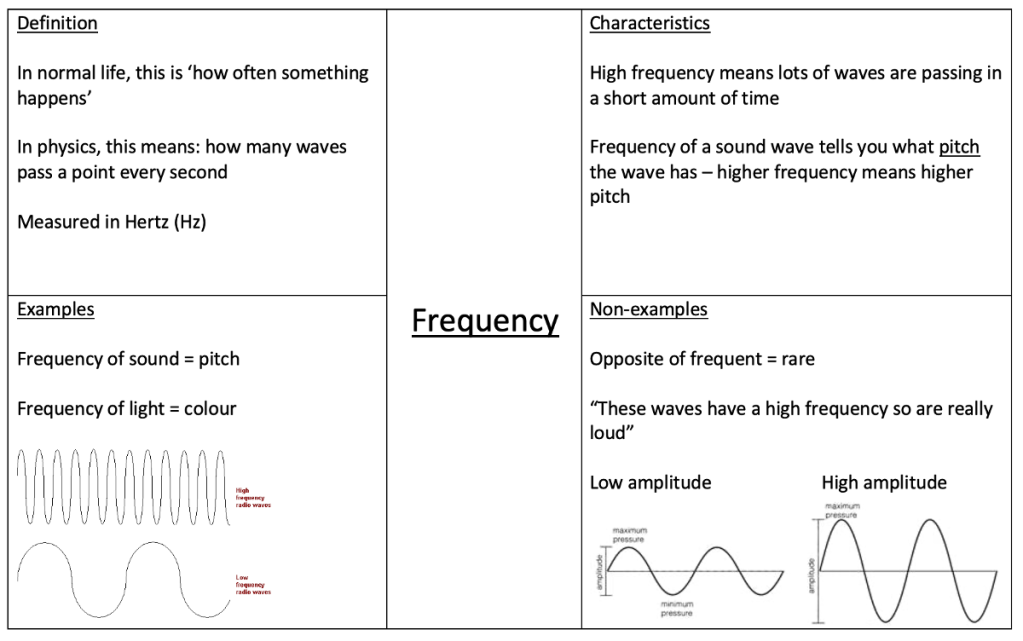
For pupils to make best use of this idea, they need to be filling in the four boxes themselves. I think I’ll probably set them as homeworks in advance of teaching, or as a revision task prior to end of topic assessments.
Whilst I think these will be incredibly useful, I’m not sure I could give a Y7 class an entirely blank template and say go; they may be quite challenging for students to complete.
Low-stakes vocabulary testing
This is as simple as it sounds. Testing pupils with small numbers of key words as starters and plenaries regularly throughout topics is one of the easiest ways of working on this. It could be ‘define the word’, or ‘identify the word I’m defining’, matching tasks, or other ways I’ve not thought of. Interleaving these vocab tests will also be really helpful in the long term.
Oracy games
You know those lessons where you finish 3 minutes early? It’s too early to let the class out but it’s too late to start a substantial task. Enter: oracy games.
Oracy refers to a student’s ability to orate; how well can they talk about a concept? Are they clear in their speech? One of the ways we’re trying to help students work on this is through short games in lessons.
This means taking a couple of minutes to play games like Hot Seat, Taboo, maybe even Pictionary, to help students practise use key vocabulary. It might even be helpful for some retrieval practice and identifying some misconceptions.
Further posts about other strategies coming soon!
Reference
Didau, D. (2014). The Secret of Literacy: Making the implicit explicit. Independent Thinking Press: Carmarthen, Wales.

 odeneal.blog
Leave a reply to Scientific literacy 3: writing about science – The Teacher-Researcher Cancel reply