
This post is the third in a series about improving the scientific literacy of our pupils. So far I’ve written about use of vocabulary and embedding additional reading into the curriculum for KS3.
Why is scientific writing important?
As I’ve said before, literacy is important beyond any one school subject’s curriculum. It can have a huge impact on someone’s ability to engage with wider society, and as part of that engagement students should be learning how to articulate thoughts and arguments they’d like to make. Writing about science will help with that.
On a more school-centric level, practising writing about topics in science, and being precise in the language used (e.g. use of key vocabulary, as I have written about before) will help with writing concise and precise exam answers. I’m not of the belief that exams are the sole purpose of a school, but it’s undeniable that they play an important part.
Strategies for embedding writing
Here I’ll discuss some suggestions for methods of embedding scientific writing, with a few examples throughout.
Comprehension
I talked about this in the post about reading in science, but I think it counts for writing too. If students are answering questions in three words or fewer then of course it’s not particularly helpful, but if the questions are designed to illicit longer pieces of writing then students will necessarily benefit from the practice.
Writing articles & blog posts
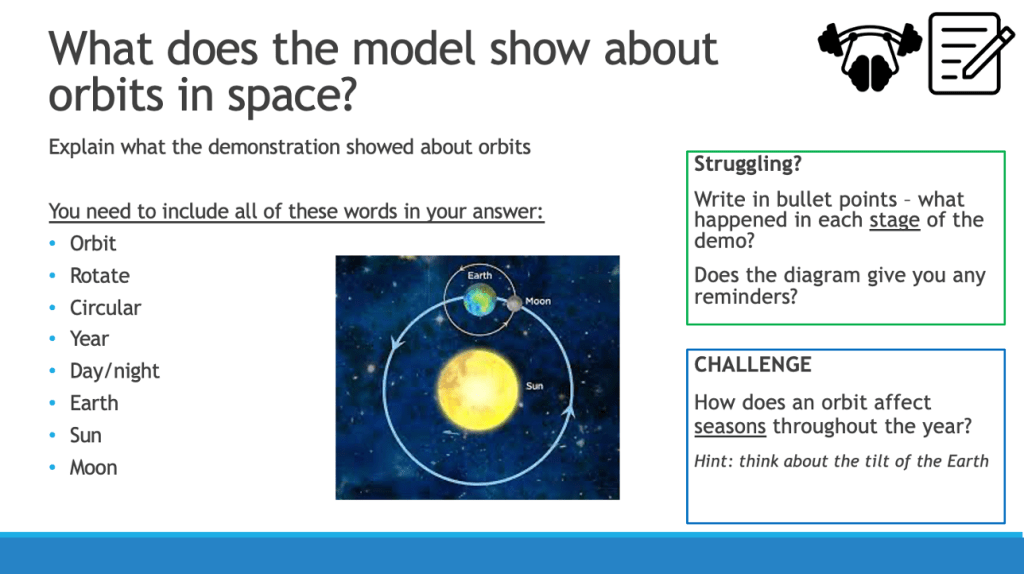
Having students write short articles about scientific concepts is an easy way to ascertain if there is understanding there. The writing specifically can be improved through the consideration of a target audience, or use of a success criteria (rather than a ‘mark scheme’) would be beneficial too.
For example, I recently asked some KS5 pupils to write an article about their favourite concept in physics in language that non-physics students could understand. This requires deeper thought about the concepts in order to explain them accurately, yet simply.

The example above covers the use of article writing in a lesson, whereas below is an example from KS5 sociology (I know this post is about science but the example stands).

Sentence stems
Nothing new here. Sentence stems (or sentence starters) to help scaffold student writing helps those who might otherwise struggle to get started, and understand what good writing looks like.
Slow writing prompts
When I helped with coaching rugby, one of the ways that we helped students to improve their gameplay was to add specific conditions to the game that make it a bit more difficult, or to encourage certain behaviours. Slow writing prompts work in the same way.
By adding conditions to the writing for students, they have to think more about how to achieve the goal they’re working toward. Examples of this might include:
- Your sentence needs to be exactly X words long
- [After a practical] Your evaluation needs to include the word ‘because’
- Your conclusion needs to include at least one piece of data from your table
- Choose at least three key words to include from: [list of key words]
Forming arguments using data
Whilst this could be something as simple as writing a conclusion from a practical (i.e. given the data you’ve collected, does this match the theory? What has a student learned from their data?), it could also be through writing exercises.
Writing an argument for a particular perspective using data (especially perspectives that someone might not hold) builds deeper thinking, and encourages use of data to form those opinions. In the world of post-truth and fake news, this tactic feels particularly helpful. I find tasks like ‘write a letter to persuade your MP about …’ a very easy way to implement this. For older students, it could be a bit more raw, asking them to ‘write a paragraph to argue X’.
Improving writing over time
All of these writing strategies will bring improvement in students’ writing if they’re getting feedback from teachers. I don’t think this necessarily means taking in books and doing in-depth marking, but ‘live marking’ and verbal feedback on aspects of student writing is imperative.
If there’s access to a visualiser in the classroom, modelling the writing from scratch can be valuable for demonstrating to students constructing the writing, and the metacognitive processes students should go through to do this successfully. Visualisers may also be useful for showing examples of student work (‘WAGOLL’ – what a good one looks like) so that other students can identify strengths of each other’s work.
Finally, collaboration with the English department on how they teach some writing techniques would be valuable, including use of PEA/PEE paragraphs and persuasive writing.
References
Didau, D. (2014). The Secret of Literacy: Making the implicit explicit.
Bates, B. (2019). Learning Theories Simplified (2nd ed.). SAGE: London.
Lemov, D. (2021). Teach Like a Champion 3.0. Jossey-Bass.


Leave a Reply